
@
Weekly Prompt
Three Elements:
Setting, Character(s), Conflict.
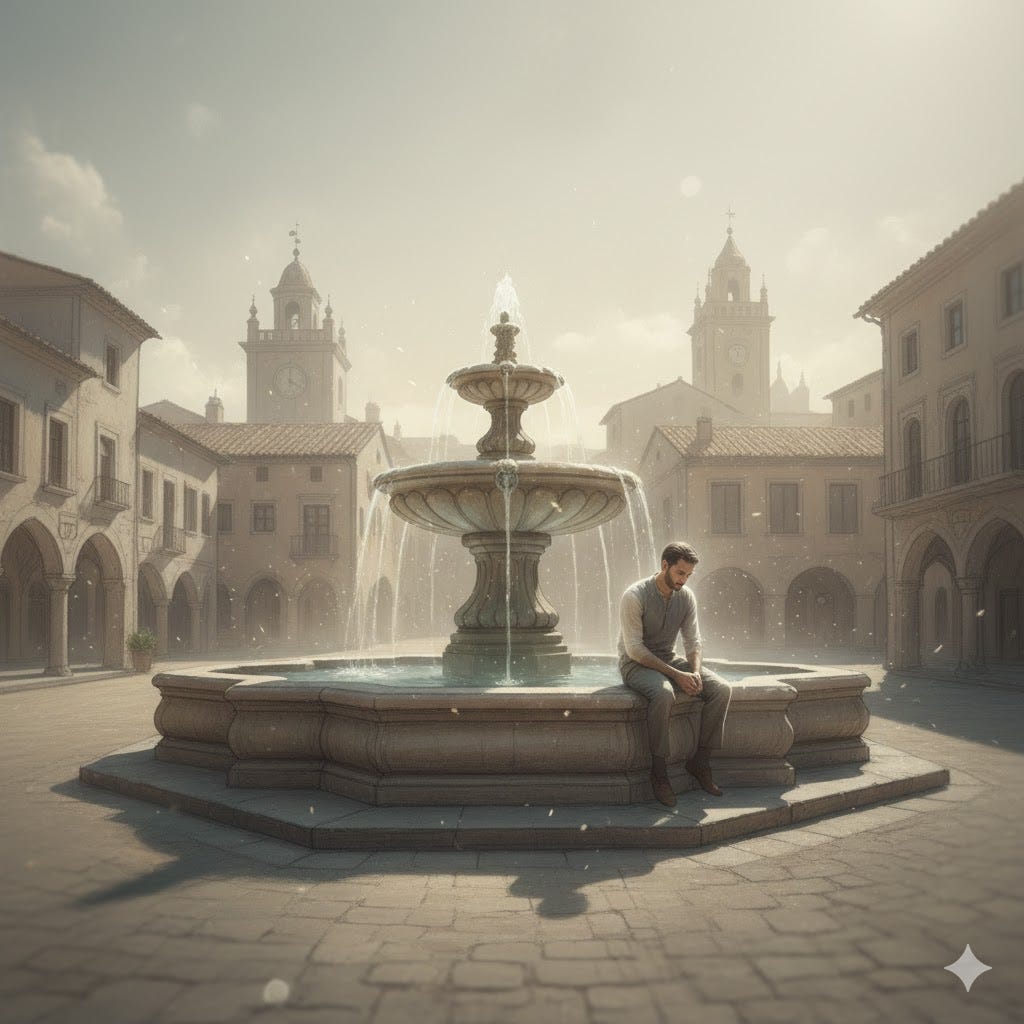
The world did not arrive with thunder or spectacle. It came the way all things do when they are meant to last - quietly. It unfolded seam by seam, as though drawn out of some hidden scene, the streets settling into their gentle curves, the buildings leaning toward one another in that intimate way that only places shaped by events ever do. The sky above held a pale, waiting stillness, neither morning nor evening, just an in-between that never quite decided itself.
This was the Margins.
A place the Writer had formed not from ambition, but from fatigue. She had grown weary of endings, tired of the way every love story she wrote carried its own diminishing. So, she shaped a world where stories were allowed to linger, half-finished, unjudged. Where discarded characters drifted after deletion. Where nothing was required to arrive at its conclusion.
She walked through it as she always did, unseen, unquestioned. The figures that passed her moved with the quiet obedience of things once imagined. Some had been kings. Some had been leftovers. Some had lived only in drafts that never hardened into certainty. They did not bow from reverence, but from recognition so deeply woven into them that they no longer questioned it.
Every soul here bore her handwriting.
Until she saw him.
He sat at the edge of the fountain that had never been fully described. The water moved as it pleased - unprompted, unmeasured, and the light that touched it came from no defined source. He was not restless. Not waiting. Not lingering with the hollow gaze of the half-written.
He was simply there.
She stopped walking.
It was a small thing, that pause - but it unsettled her. She had written even her own steps until now, every path anticipated, every hesitation archived. Yet here she stood, halted by a presence she could not place.
She searched him instinctively, with that inner reach she used to trace the memories of a life, its origin, its ache, its ending.
There was nothing.
No tether to authorship.
No mark of revision.
No softened edge of abandonment.
He did not belong to the Margins.
“Who made you?” she asked.
The question was not sharp. It had never needed to be.
He lifted his head slowly, as though the idea itself took time to find him.
“No one,” he said.
His voice did not ripple through the world the way unrehearsed sound should. It did not fracture the air or tremble with variation. It settled. As if it had always been meant to be there.
“That isn’t possible,” she said quietly.
He smiled, not with challenge, not with charm - but with the gentleness of someone unused to being disputed.
“You’re accustomed to being right,” he said.
Something shifted in her chest then. Not danger. Not fear. But the faint, unfamiliar loosening that comes just before a truth rearranges you.
She moved closer. The world did not adjust itself; the sky did not falter. Nothing changed to confirm her authority.
He did not alter.
“Everything in this place has been written at least once,” she said. “Even what was erased.”
“Then I must not be from here,” he replied.
She searched him again, more carefully this time. There was no story folded beneath his skin. No future waiting behind his eyes. No ending placed neatly at his back.
For the first time in all the years of shaping and severing, of choosing who would live and who would not, she stood before a life untouched by intention.
“You shouldn’t exist,” she said, not unkindly.
“And yet,” he answered, “you’re standing here with me.”
She had written love before. Had watched it rise and fail in a thousand unusual ways. She had known devotion that wrapped itself in tragedy and desire that arrived already bruised.
But this was neither.
This was something she could not place.
“What do you do here?” she asked.
He glanced around the Margins, the half-finished world breathing softly around them.
“I listen,” he said. “To the places where the story weakens.”
That unsettled her more than defiance ever could.
“And what do you hear?”
He met her gaze without reverence, without fear.
“Longing,” he said.
The word moved between them silently.
And in that quiet space, where nothing had been written yet - something began for which she had not allowed.
Not wonder.
Not control.
But the terrible, beautiful unease of not knowing what would come next.
They did not speak again for a while.
The fountain moved as it always had, though she was certain now it listened. The water curved against the stone lapping the edges softly as if whispering. The sky did not shift its colour. The Margins remained suspended in their quiet, unfinished state. Only she had changed.
She sat at the fountain’s edge without quite deciding to. It did not feel like a choice. It felt like relief.
He remained where he was, close enough that she could sense the warmth of his presence without being crowded by it. Not one of her characters had ever learned that distance. They either pressed too hard with their need or faded into obedience.
“You’re not afraid,” she said.
He considered this.
“Of you?” he asked gently. “No.”
“That alone should frighten you.”
A faint smile touched his mouth. “You mistake fear for understanding.”
She studied him then with the careful attention she usually reserved for flawed passages - the shape of his hands, the effortless way he held his shoulders, the steadiness of his gaze. There was no stiffness in his posture. Nothing ornamental. No symbolic weight assigned. He existed as one might in a real room - debonair, unguarded, entirely unnecessary.
She had never written unnecessary before.
“What would you do,” she asked slowly, “if I chose to end this moment?”
He did not answer at once. Instead, he skimmed a finger through the fountain water, watching the ripples fade without instruction.
“I would grieve it,” he said at last. “But I would not be erased by it.”
That answer landed somewhere beneath her ribs.
She had built whole worlds on the assumption that existence was granted at her pleasure. Even she herself had lived that way - measured by what she produced, what she resolved, what she brought to conclusion.
This man did none of that.
“Do you know what it is to be written?” she asked.
“Yes,” he said quietly. “I just no longer belong to it.”
That unsettled her more than any rebellion.
They sat like that for a long while. At some point the light shifted from colourless to pale gold, as if evening had finally decided to awaken. She felt the ache, a gentle pull behind the eyes, the way memory pings before it knows what it will become.
“You answer as if you’ve already lived,” she said.
“I have,” he replied simply. “Just not in your language.”
She did not know why that moved her so deeply.
No one had ever spoken to her from outside the design before. Everyone else had always been a reflection of some choice she once made - some mercy she edited in, some consequence she carefully arranged.
He offered nothing that belonged to her.
And yet, here he was.
“What do you want?” she asked.
The question surprised her as much as it surprised him.
He thought for longer this time.
“To wake without knowing the chapter,” he said. “To walk without carrying an ending in my pocket. To love without rehearsal.”
The words hung between them.
Love.
She had written it into wars. Into betrayals. Into impossible homes.
Never into safety.
“I don’t know how to make that,” she said.
“I know,” he replied. “That’s why it matters.”
The stillness deepened then, not with anticipation, but with something gentler and far more dangerous - recognition.
For the first time in all her dominion over stories, she did not feel powerful.
She felt present.
And in that quiet space, where no script yet reached, something began warming that could not be edited without cost.
The quiet between them softened.
It was she who spoke first, though later she would not remember choosing to. It felt more like a truth rising, no longer willing to be kept buried.
“I was taught early,” she said, “that control was kindness. That if I shaped things carefully enough, no one would be hurt more than necessary.”
Her eyes rested on the water as she spoke. It was easier that way.
“And did it work?” he asked.
She gave a small, almost-smile. “It worked beautifully on the page.”
He did not press her. That, too, was new.
“In life,” she continued, “it made me lonely. People behave differently when they sense that you are always holding the ending.”
He understood that without explanation.
“I learned to end things before they could end me,” she said. “I told myself it was wisdom. It was often just fear dressed in control.”
She waited for the familiar recoil, the discomfort, the retreat. It did not come.
Instead, he said quietly, “Fear can be disciplined without being controlled.”
That simple truth loosened something in her chest.
After a while, she asked, “And you? What makes you careful?”
He did not answer at once. When he did, his voice was steady, but it carried the weight of long-held knowledge.
“I have been lived through,” he said. “Taken into other people’s meaning without being consulted. Named for things that were never mine. I learned to survive by staying undefined.”
She turned then, fully.
“And now?”
“Now,” he said, “I am tired of surviving at the cost of being known.”
The admission trembled slightly in the air between them.
She felt it - that familiar inward step she usually avoided. The place where power gives way to exposure. Where the writer becomes only a woman sitting beside another human being.
“I don’t know how to meet someone without arranging their place,” she said. “I don’t know how to love without shaping.”
He met her gaze gently. “Then we will both be beginners.”
Something in her gave way at that.
She had begun many things in her life - books, worlds, departures, reinventions. But she had almost never begun without advantage.
This would be different.
“I am afraid,” she said simply.
“So am I,” he answered. “But not in the same way.”
The fountain continued its patient music. The light lowered another shade toward evening. They got up and moved away from the fountain. He reached for her hand. She felt a light tingle in her palm.
No promises were made.
No futures were claimed.
But between fear and unknowing, something honest settled - not certainty, not safety yet - only the quiet courage of two people no longer hiding behind what they could control.
And that, she realised, was the most vulnerable chapter of all.
They stopped where the path widened again, just before it returned them to the world they had stepped away from.
The light was lower now. The air cooler. Evening doing its quiet work of asking things to slow.
Neither of them let go at first.
There was no urgency in the pause - only that strange knowing that comes when something has shifted without announcing itself. The kind that doesn’t need words because words might make it smaller than it actually is.
Her thumb moved once against his hand. Not a signal. Not a question. Just a truth passing through skin.
“I should go,” she said gently.
“I know.”
Still, neither moved.
Somewhere behind them, the day closed a door. Somewhere ahead, life waited with all its noise and complication. But here - in this narrow pocket of almost - there was only breath, warmth, and the quiet bravery of what had just been offered.
She smiled then - not brightly, not bravely, but with that soft steadiness that comes from being seen without being consumed.
“Thank you,” she said.
He nodded. “For walking with me.”
“For not asking me to run.”
They continued walking forward.
And neither of them looked back.
Not because nothing mattered.
But because something did.
And it would keep.
They stopped where the path thinned, where the trees no longer sheltered them and the town’s first sounds began to rise again - a door closing, distant laughter, life resuming where they had briefly stepped outside of it.
The light had softened. The hour had changed.
So had she.
There was something unsaid between them now - not avoidance, but weight. The kind that comes when you know the last honest thing is already standing in the room with you.
“You’re quiet,” he said.
She looked at him, really looked at him, as if committing a face to memory rather than answering a question.
“I’m trying not to be a coward,” she said.
That was all.
He understood enough.
Her fingers tightened once around his, then loosened. Slowly. Deliberately. Like someone unfastening themselves from a life they had briefly imagined.
When she stepped back, he felt it - not like rejection, but like the withdrawing of tide.
“You won’t remember me,” he said, not accusing. Just stating what already trembled between them.
She swallowed. “I think some part of you will remain. Even if the world forgets.”
That was the mercy she could offer.
She lifted her hand then - not to wave, but to touch his chest lightly, just once, as if placing him back into the story where he had always lived.
And then - she turned.
No drama.
No tearing goodbye.
Just the quiet authority of someone choosing the ending.
Behind her, a character stood very still.
And when she reached the end of the path - when the last line was finally written - he was gone.
Not erased.
Finished.
I am genuinely grateful that you spent time reading this prompt. Truthfully, Bradley Ramsey you set a difficult promt this time.
This is beautifully crafted, a world that feels both fragile and enormous, built on the quiet tension between creation and autonomy. I love how you let the Writer confront something she can’t control, and how that encounter softens her instead of breaking her. The whole piece moves with a gentle inevitability, like a truth unfolding at its own pace. It’s one of those stories that lingers long after the last line, carrying its own stillness.
That was an amazing read Brenda, Thanks for sharing!!!