
Cosmic Feast! Fourth Narrative Feast Prompt
What Unseen Force (or god) is Pulling the Strings?
Can Its Agenda (or Arrival) be Stopped?
What Forbidden Truths Will Come to Light?
Lord Devereaux! The Devourer of stories. The Taster of Tales. The Consumer of Characters - Here is my tasty morsel for this weeks prompt.
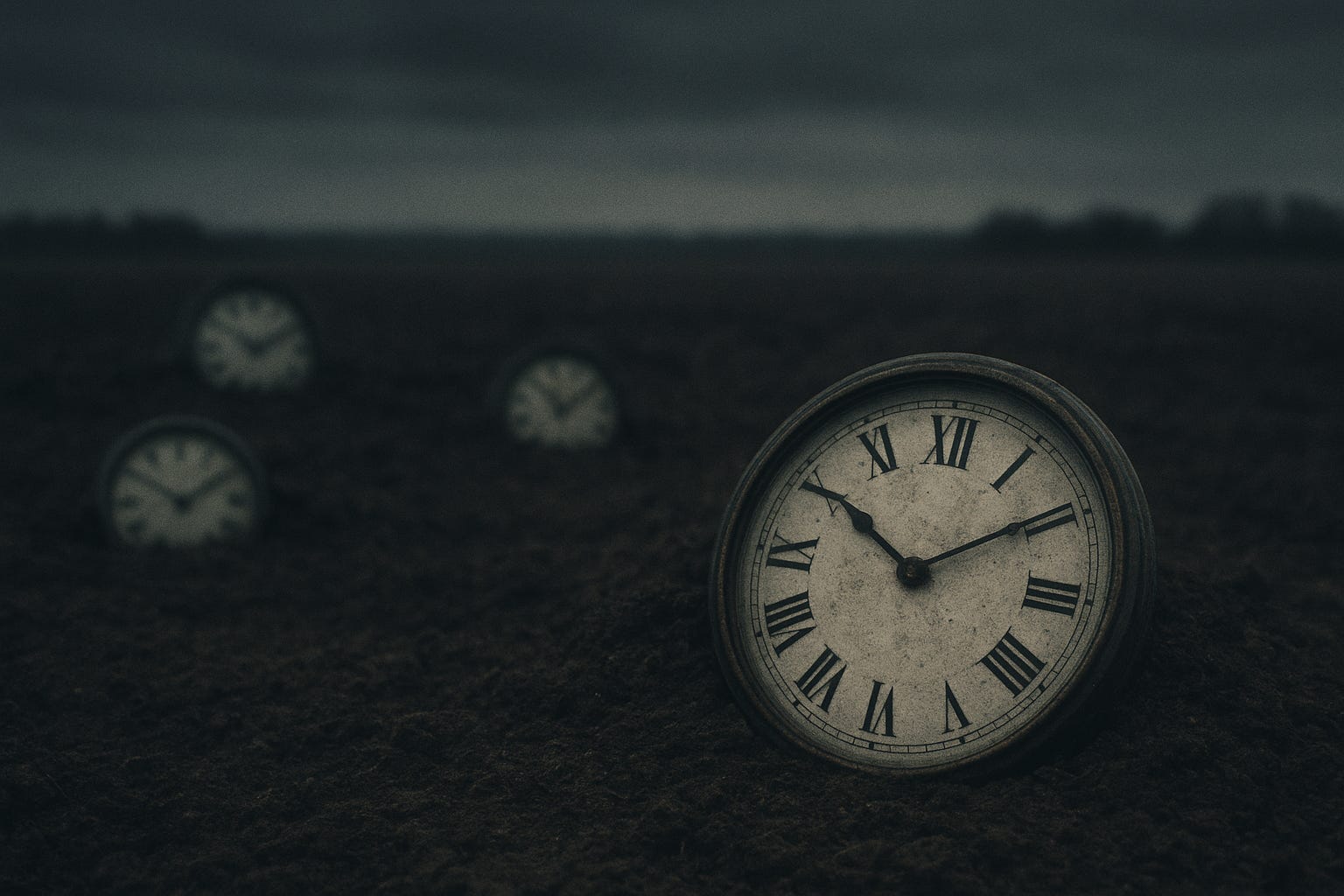
My family-built clocks. Big ones. The kind that end up in churches, courthouses, city halls. The kind that don’t stop, even when the people who wound them are long gone.
We’ve been at it since before anyone kept proper records. The old ledgers just say The Guild of Timewrights. That was our lot. My father used to joke that if every clock we made struck midnight at once, the world would end. He said it like it was funny.
When he died, the job came to me. I travelled to service the old mechanisms, some still working, others choked with dust and pigeons crap. They all had our mark hidden inside the casing - a spiral carved into the brass. I never thought much of it. Tradition, I figured. Every craftsman leaves a fingerprint.
But one night, while cleaning the tower clock in Darnham, I heard another one ticking, not from the gears in front of me, but from the stone walls around. A slower, deeper sound. Like a second heartbeat under the earth.
Later, in London, I found the same pattern. Same pulse. Different tower. It was faint, but always there, like they were answering each other across distance.
I started charting them, Bristol, York, Antwerp, Prague. All our clocks. All still running, all with that same undertone. When I lined the cities on a map, the marks formed a shape. A spiral, just like the guild symbol.
And then, last month, the one in Prague stopped. Not wound down - stopped. Dead still. That same night, the one in Antwerp lost six seconds. York gained four. Something shifted.
Now the clocks don’t just tick, they whisper. And when they strike midnight, the sound doesn’t echo. It shakes.
Faltering Clocks
My father said our family were chosen, not trained. I never understood that until the day I heard the ticking falter. The clocks in our house, thirty-seven in all - had always kept perfect rhythm. Then, one November morning, the carriage clock on the mantel gained four seconds. Whatever I did the seconds would not return.
By evening, I had aged two days.
It was not visible to others, but I knew. The marrow felt old, the eyes, grainier. I wrote to the Order, sealed the note in wax. Two days later, the reply came unsigned: “Attend. The Dominion stirs.”
We gathered again, this time in an old observatory beyond Oxford. The walls still carried soot from wartime blackouts. In the dome’s centre, beneath the great iron ribs, stood a clock none of us had seen before, its dial a spiral of brass, its hands like compass needles twitching as if locating an unseen pole.
Master Wren spoke softly: “This is not a clock. It is a mouth.”
The room grew cold. Someone whispered that Time had begun to reclaim its voice, that our keeping of time, our measuring, and our diligence - had offended the Dominion.
I did not believe it until the clock turned its hands backward. The air thickened; the candle flames leaned, drawn to the spiral. I heard it then, deep within the mechanism, a sound - not unlike breathing.
The Dominion
The Order argued through the night. No one spoke loudly. The kind of fear that leaves chills, the fear of being wrong about everything.
Wren said we had stolen seconds that were not ours. That the Dominion had allowed it, for a while, to see what we would do. Now it wanted them back.
The younger men disagreed. They spoke of magnetic fields, errors in calibration, time itself. They talked until the candles started to splutter. None of it silenced the ticking beneath the floor.
By dawn, one of the clocks in the antechamber stopped. We heard it. Not the ceasing of sound, but the absence, the way the air changed and became still.
An hour later, Wren’s hand withered. The skin drew tight, as though pulled into the bone. He did not cry out. Just said, “We have touched the Meridian.”
After that, the room emptied. Some fled. Others prayed.
I stayed. I don’t know why. Perhaps because I had felt it too - that faint tremor in the chest, my heart ticking out of rhythm.
When silence settled, I turned back to the spiral clock. Its dial had changed. The hands were gone. In their place, a shadow that moved on its own accord, circling the brass edge like ink drawn to a line.
I said, not aloud but inwardly: What are you?
The answer came slow, almost human.
Keeper.
The word filled the room. It was not sound. It was weight of centuries pressing into the ribs, the memory of every hour ever stolen.
The Dominion had spoken.
Rhythm
By evening the Order reconvened, what remained of it. Wren was gone, his chair left at the table, no one touched it.
Every clock in the observatory now ticked out of step, as if time itself had splintered. The sound was unbearable, a chorus of irregularity.
They brought out the old texts, the leatherbound ledgers from before the guild had a name. Some of the writing was in a script we no longer read. Others, newer, warned of something called the Meridian Fold - a divide where timekeepers forget the covenant.
The older members remembered fragments of the rite - how the first Time-wrights sealed the Dominion’s access by synchronising every clock at the world’s centre, a task never repeated. The purpose had been preservation, not control. We had mistaken it.
Now they meant to repeat it.
A dozen of us stood around the spiral clock, each holding a pendulum taken from one of our towers. The idea was to bring the ticks back into rhythm, to make the pattern whole again.
It almost worked. For a heartbeat, the air felt right. Then one pendulum – mine, swung out of rhythm.
The spiral clock split along its dial. Light, colourless, and fine, flowed through the crack and tilted the room. Some fell to their knees. Others aged before our eyes, their faces changing in a fast-motion blur.
I dropped the pendulum. It hit the floor and still swinging, though nothing moved it. The air hummed.
The Dominion was awake.
And then I knew, it wasn’t just claiming back time. It was claiming us.
When the clocks stop, people die. When they gain, they age faster. The towns with our clocks will fall out of sync, hours slipping from their people like sand through glass. The Meridian Fold has begun.
We must reach the first clock, the one my ancestor built before there were cities or calendars. The true centre. If it still turns, perhaps it remembers the covenant.
The Meridian Order
I was born to the craft, as my father was, and his before him. In our house, time was not measured but tended. Every cog, every pendulum, every tooth was a heartbeat of the world. The Order said we were chosen. That ours was no mere trade, it was preservation. For if time were ever to slip, the balance of all things would fail.
The clocks we made were not clocks. They were timepieces - holding seconds, years, and ages against the pull of the universe. Some gained, some lost, and each deviation carried a consequence unseen. A village might wake to find its elders turned to ash overnight. Elsewhere, a child’s cradle empty, its occupant born too soon into another century.
When the first of the Grand Time Regulators stopped, the air itself grew old. Birds forgot how to sing. Candles would not stay lit. The Order gathered in the cellar beneath the observatory. We spoke in the old tongue, the one reserved for such times. There was fear in the silence between us, and guilt we could not name.
We thought to summon Time itself, the Dominion beyond all dominions; to beg repair. But when the petition commenced, the light became iridescent, and the sound of the world ceased. We felt the weight of something watching from before creation. We knew then we had not summoned Time. Time had been waiting.
Now, the clocks no longer obey us. Their hands move of their own accord, each marking a bargain we never struck.
But the ticking follows me now, louder each mile. Not from any clock. From my chest.
I keep walking.
The Order still meets, though fewer of us return each season. We speak of containment, of closing the distance between what ticks and what breathes. Yet none can say which side of the glass we now stand on, the keeping, or the kept.
And sometimes, when I dream, I see them - the clocks we buried, faces upturned like the dead, waiting for the hour we no longer dare to name.
🕟
A very difficult prompt - the first time I entered the world of Cosmic Horror. No, I realised, it is not about stars and galaxies. I did a lot of watching, reading, asking and researching. I hope that this brings you a slight tremour, an eerie feel and a chilly encounter.
🕕
Thank you for reading. If this story left a thread of thought flowing, know that your readership is the most valuable currency a writer can have. I am grateful that you came to spend time here. If you would like to officially join this growing community please subscribe. You can invest in this ongoing creative pen by becoming a paid subscriber. Let’s keep building this world together.
So good Brenda. 😊
This is a haunting and beautifully crafted piece. The atmosphere builds slowly, tightening like the gears of the clocks themselves. The imagery feels ancient and alive, filled with quiet dread and reverence. You’ve captured the essence of cosmic horror through something deeply human, the fear of time slipping beyond our control. The line “We knew then we had not summoned Time. Time had been waiting.” lingers like an echo, both chilling and profound.